
Every founder entering the mobility market begins with the same dream: build a regional Uber, capture local market share, and scale to thousands of daily rides.
Yet the vast majority of new ride hailing projects fail during their first commercial spike. The failure almost never occurs because riders dislike the buttons on the screen. It happens because traditional software architecture collapses the moment hundreds of drivers emit continuous GPS telemetry while hundreds of passengers simultaneously request immediate dispatch.
"A ride hailing platform is not an app with a database. It is a distributed state machine managing concurrent real world collisions under sub three second latency constraints."
1. The Fallacy of Relational Databases for Real Time Dispatch
The most prevalent architectural blunder we witness in early ride hailing prototypes is writing driver location coordinates into MySQL or PostgreSQL every three seconds.
Consider the math: one thousand active drivers updating latitude and longitude every three seconds equals 333 write transactions per second. Add concurrent passenger searches, spatial bounding box queries, and ride state updates, and your relational database will quickly experience connection pool exhaustion, table locking, and crippling latency spikes.
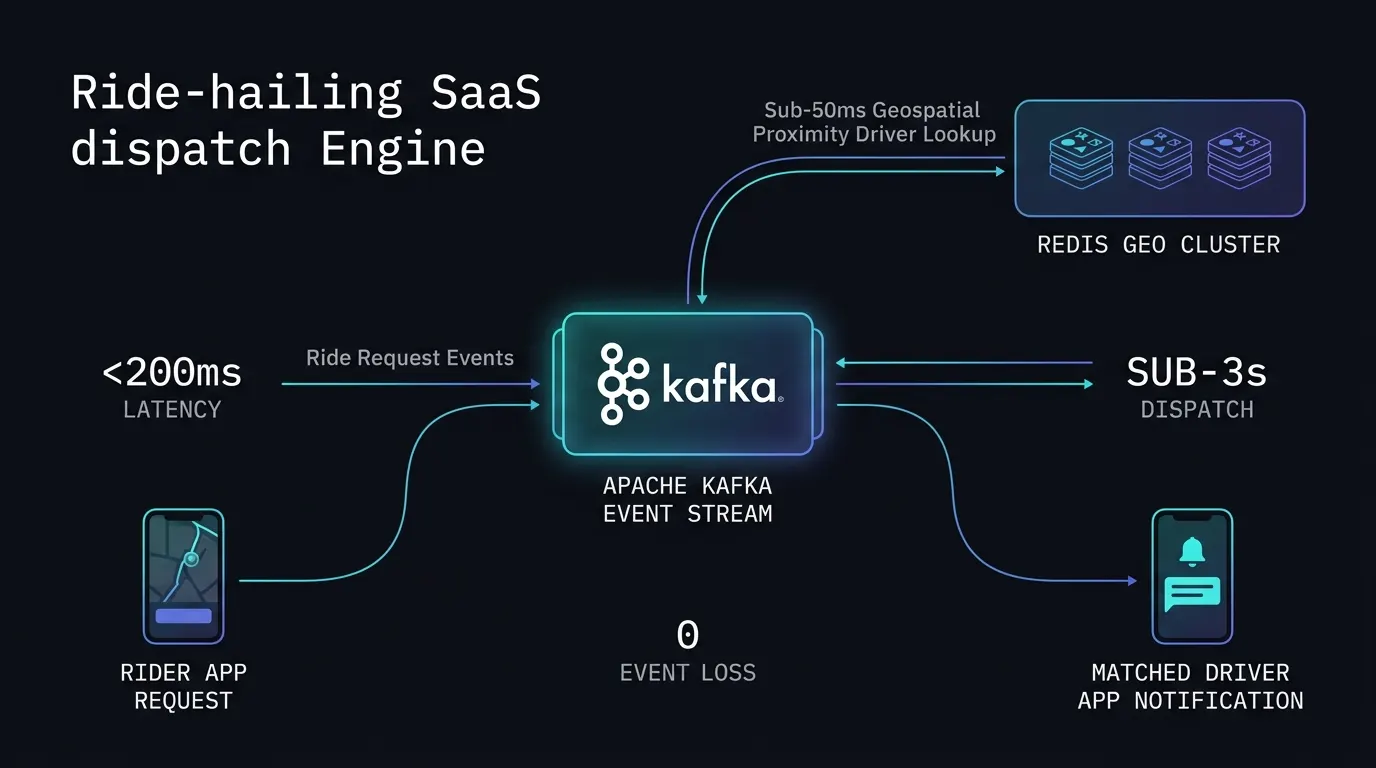
The correct solution is in memory geospatial indexing via Redis GEO. Using commands such as GEOADD and GEORADIUSBYMEMBER, we update driver positions in microsecond memory cycles and calculate the nearest twenty available drivers within a three kilometer radius in under forty milliseconds.
2. Dispatch Serialization: Why Kafka Prevents Race Conditions
What happens when two riders standing on the same street corner tap "Request Ride" at the exact same fraction of a second? If both requests target the same solitary available driver, an unsequenced backend will offer the trip to both phones, causing ride collision and instant operational distrust.
We resolve this utilizing partitioned Apache Kafka event streams. Every ride request enters an immutable queue. Our dispatch matching service processes requests sequentially per geohash zone, claims an exclusive distributed lock on the selected driver for fifteen seconds, and transmits the job invitation through WebSocket tunnels.
In two years operating OH! Ride across Sri Lanka with over 600 Kafka events per minute, this architecture has maintained zero double booking incidents and zero lost ride requests.
3. Driver Economics: The Subscription Revolution
Traditional ride hailing incumbents charge drivers twenty to thirty percent commission on every completed fare. In many competitive markets, drivers resent this deduction and seek alternative platforms.
A proven alternative is the SaaS subscription model: drivers pay a flat weekly or monthly membership fee (for example, $15 USD per week) and keep one hundred percent of their earned passenger fares.
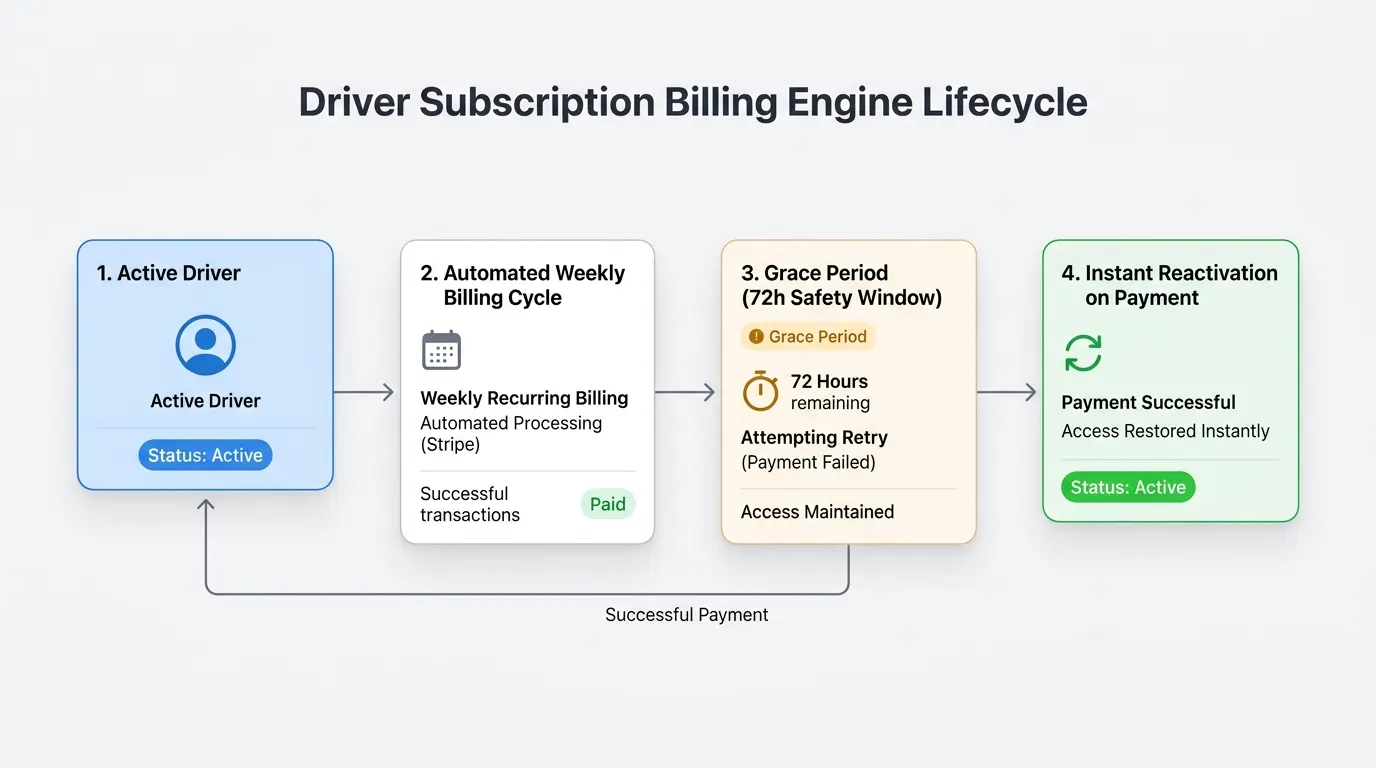
Automating this lifecycle is non trivial. The system must process recurring mobile wallet payments, trigger automated 72 hour grace period warnings if renewal fails, temporarily suspend dispatch capability upon expiration, and instantly restore full driver online access the second payment settles. We engineered this entire workflow into our mobility core.
4. Cross Platform Mobile Engineering: React Native
Building separate native iOS (Swift) and Android (Kotlin) codebases doubles your initial engineering payroll and fragments bug triage. We build our passenger and driver suites using TypeScript and React Native.
By leveraging native thread bridge optimizations, background location workers, and optimized vector maps, our applications sustain a silky 60 frames per second UI while sharing over eighty five percent of logic between iOS and Android.
5. The Tailored Production Pilot
If you want to validate your city or regional market, you do not need to spend six months and $150,000 USD on speculative development. We deliver an end to end personalized pilot in 8 to 10 weeks tailored to your market:
- One custom branded Passenger App (iOS and Android)
- One custom Driver App with live job acceptance and turn navigation
- One central Dispatcher and Operations Dashboard
- Full deployment into your own dedicated cloud infrastructure